
Many customers report that after using metal honeycomb substrates for a period of time, they experience aging, failure, and reduced purification efficiency. This not only increases replacement costs but also affects the normal operation of the exhaust system. In fact, by mastering the correct usage and maintenance methods, you can effectively extend the service life of metal honeycomb substrates and reduce operating costs.
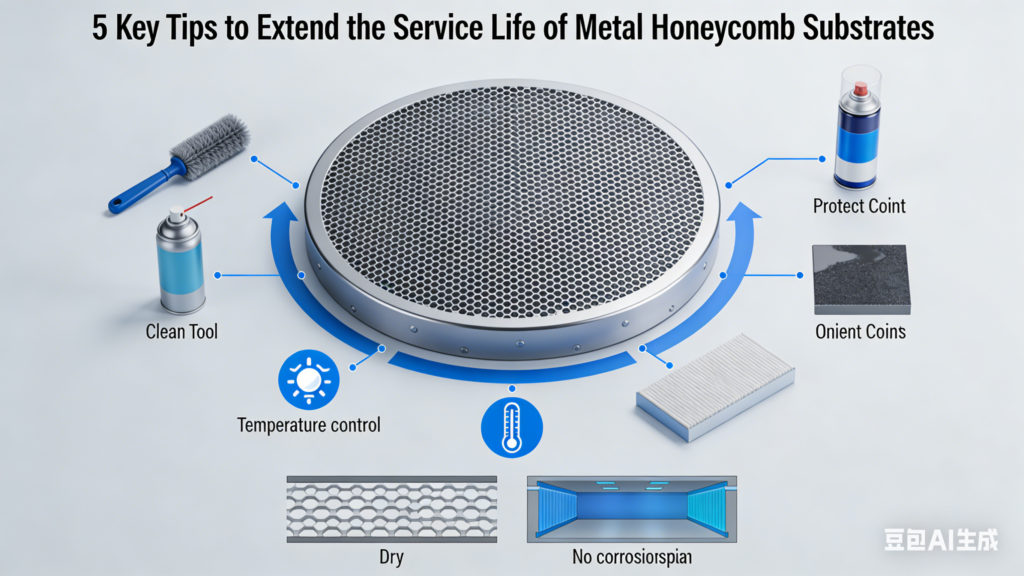
Extending the service life of metal honeycomb substrates hinges on five key points: selecting the appropriate specifications, ensuring fuel and oil quality, avoiding engine malfunctions, performing regular inspections and maintenance, and ensuring correct installation. Mastering these five points can increase substrate service life by over 30%, allowing you to fully leverage their performance advantages.
As a professional manufacturer, we have summarized these five key points based on years of product development and customer feedback, helping global customers use metal honeycomb substrates more effectively.
Key Point 1: Select Appropriate Specifications to Avoid Premature Failure Due to Mismatching
Specification mismatch is one of the primary causes of premature failure in metal honeycomb substrates. Many customers blindly choose high-CPSI substrates in pursuit of purification efficiency, neglecting engine compatibility.
The correct approach is to select the appropriate CPSI and dimensions based on engine displacement, exhaust flow rate, and application scenario. For large-displacement, heavy-duty engines, choose 400 CPSI low back pressure substrates to avoid excessive back pressure that could cause engine overheating and damage the substrate. For small-displacement engines in stringent emission scenarios, 600/900 CPSI substrates can be selected, balancing purification efficiency with service life.
Additionally, custom-shaped substrates are necessary for non-standard applications to avoid deformation or damage from forced installation, which would impact service life.
Key Point 2: Ensure Fuel and Oil Quality to Prevent Substrate Poisoning
Poor fuel or oil quality can lead to substrate poisoning, rapidly reducing purification efficiency and shortening service life. This is a factor often overlooked by many customers.
Regarding fuel, use high-quality fuel that meets local emission standards and avoid low-quality fuel with excessively high sulfur content. Combustion of inferior fuel produces large amounts of sulfides that adhere to the substrate surface, clogging channels and destroying the catalyst coating, leading to substrate failure.
Regarding oil, choose high-quality oil suitable for the engine and avoid excessive oil consumption or oil entering the exhaust system. Additives in oil can form carbon deposits at high temperatures, adhering to the substrate surface and affecting exhaust flow and purification efficiency. Over time, this leads to substrate aging and damage.
Key Point 3: Avoid Engine Malfunctions to Reduce Substrate Damage
Engine malfunctions can directly damage metal honeycomb substrates, leading to premature failure. Timely diagnosis and resolution of engine issues are necessary to protect the substrate.
Prevent Engine Misfire: Engine misfire allows unburned fuel to enter the exhaust system, where it can ignite violently on the substrate surface, generating high temperatures that burn the coating and cause substrate deformation or cracking.
Control Engine Temperature: Avoid prolonged engine operation under high-temperature conditions. High temperatures accelerate substrate oxidation and aging, shortening service life. If the engine experiences overheating issues, diagnose and resolve the fault promptly to prevent substrate damage.
Prevent Engine Oil Leaks: Oil leaks allow oil to enter the exhaust system, forming carbon deposits that clog substrate channels and affect performance. Repair leaks promptly.
Key Point 4: Perform Regular Inspections and Maintenance to Identify Issues Early
Regular inspection and maintenance are crucial for extending substrate service life, allowing potential problems to be identified before they escalate.
Regularly Inspect Substrate Appearance: Every 6 months or 10,000 kilometers, inspect the substrate’s appearance for any signs of damage, deformation, or leaks. If damage is found, replace the substrate promptly to avoid affecting the exhaust system and other components.
Regularly Check Purification Efficiency: Every year or 20,000 kilometers, test exhaust emissions. If reduced purification efficiency is detected, it may indicate clogged substrate channels or aged coating. Professional cleaning can restore performance, avoiding premature replacement.
Regularly Clean the Substrate: Depending on the application scenario, perform professional cleaning of the substrate every 20,000–30,000 kilometers to remove surface carbon deposits and impurities, unclog channels, restore exhaust flow and purification efficiency, and extend service life.
Key Point 5: Ensure Correct Installation to Avoid Damage from Improper Installation
Improper installation can cause deformation or damage to metal honeycomb substrates, affecting their service life. Pay attention to the following three points during installation.
Apply Moderate Force During Installation: Avoid using excessive force during installation to prevent substrate deformation or cracking. Follow the installation guide to correctly secure the substrate, ensuring it is firmly fixed without looseness.
Ensure Seal Integrity: Ensure a proper seal between the substrate and the exhaust pipe during installation to prevent leaks. Leaks can cause uneven exhaust temperatures, leading to localized high temperatures that damage the substrate.
Avoid Installation Misalignment: Ensure the substrate is oriented correctly during installation and avoid misalignment. Misalignment can increase exhaust resistance and cause uneven stress on the substrate, accelerating its aging.
Frequently Asked Questions
If the substrate has minor carbon deposits, can I clean it myself?
Self-cleaning is not recommended. DIY cleaning may damage the substrate coating and affect purification efficiency. It is advisable to seek professional repair services that use specialized cleaning equipment and agents for professional cleaning.
How should a substrate be handled after its service life expires?
When the substrate reaches the end of its service life, it should be replaced promptly to avoid affecting exhaust emissions and engine performance. When replacing, choose a metal honeycomb substrate with specifications identical to the original to ensure compatibility, and have it installed by a professional.
Should the maintenance schedule be adjusted for different application scenarios?
Yes. For harsh scenarios such as heavy-duty, industrial, or dusty environments, the substrate operates under more severe conditions, and the maintenance schedule should be shortened. It is recommended to inspect every 3 months or 5,000 kilometers and clean every 10,000–20,000 kilometers. For standard passenger vehicle scenarios, the regular maintenance schedule can be followed.
Conclusion
Extending the service life of metal honeycomb substrates does not require complex operations. By mastering these five key points—selecting appropriate specifications, ensuring fuel and oil quality, avoiding engine malfunctions, performing regular inspections and maintenance, and ensuring correct installation—you can effectively increase substrate service life, reduce operating costs, and fully leverage its performance advantages.