
Have you noticed that even with the same type of metal honeycomb substrate, purification efficiency can vary significantly? Many manufacturers neglect the optimization of cell structure, resulting in insufficient specific surface area and uneven gas flow distribution. Even when using high-quality FeCrAl alloy, the ideal purification effect remains elusive. With years of experience in substrate research and development, we have achieved over 20% improvement in purification efficiency through precise cell structure optimization, perfectly meeting stringent emission requirements.
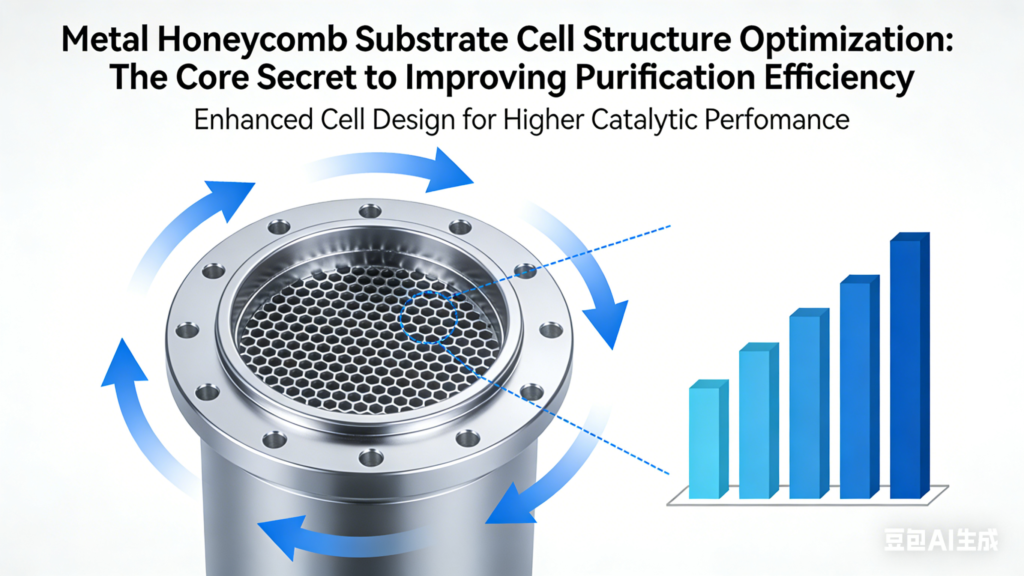
Our metal honeycomb substrates utilize an optimized cell structure. By adjusting cell density, cell shape design, and cell arrangement, we maximize specific surface area, optimize gas flow distribution, and reduce back pressure. This approach enhances purification efficiency while maintaining engine power performance, adapting to major global emission standards such as Euro 6 and EPA.
Cell structure is the “core lifeline” of a metal honeycomb substrate, directly determining purification efficiency and operational performance. Today, we will break down the core secrets of cell structure optimization, revealing the “inherent advantages” of a high-quality substrate.
Why Does Cell Structure Determine Purification Efficiency?
The purification principle of a metal honeycomb substrate involves exhaust gas passing through the channels and making full contact with the catalyst coating on the channel walls, thereby breaking down pollutants. The rationality of the cell structure directly affects the contact area and gas flow smoothness, which in turn determines purification efficiency.
If the channels are too wide, the exhaust gas velocity is too high, resulting in insufficient contact time with the catalyst, incomplete decomposition of pollutants, and low purification efficiency. If the channels are too narrow, while the contact area increases, back pressure rises, affecting engine power, increasing susceptibility to clogging, and shortening the substrate’s service life.
The core of our cell structure optimization is finding the balance between “contact area” and “gas flow smoothness,” ensuring exhaust gas thoroughly contacts the catalyst while passing through smoothly, achieving a dual improvement in purification efficiency and power performance.
Furthermore, a rational cell structure enhances precious metal utilization, reduces catalyst consumption, and lowers production costs for customers. This is one of the core competitive advantages of our export products.
Core Optimization 1: Precise Matching of Cell Density (CPSI)
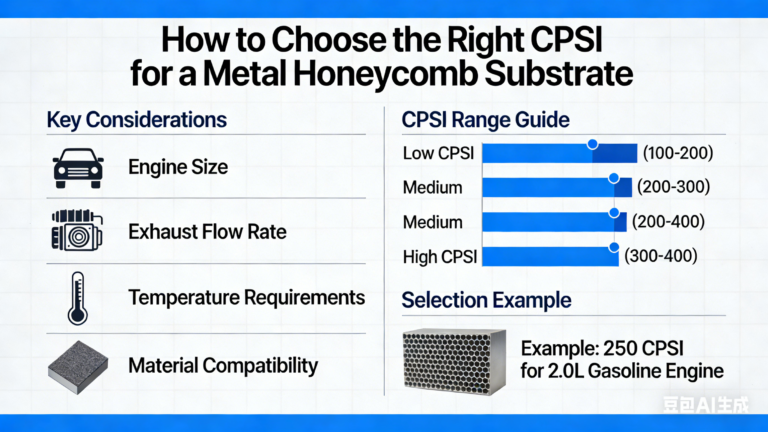
Cell density (CPSI) is the foundation of cell structure. Different applications require different cell densities; blindly pursuing high CPSI can be counterproductive. We achieve precise matching optimization of cell density based on application requirements.
For small-displacement passenger vehicles and stringent emission scenarios (e.g., European and North American markets), we use a high cell density design of 900 CPSI. The finer channels provide a larger specific surface area, allowing exhaust gas to contact the catalyst more thoroughly, achieving purification efficiency of over 95% and easily meeting Euro 6 and EPA standards.
For large-displacement, heavy-duty engines (e.g., trucks, construction machinery), we use a low cell density design of 400 CPSI. The wider channels offer low exhaust resistance and back pressure, avoiding impact on engine power while maintaining basic purification efficiency, suitable for heavy-duty scenarios in markets like Southeast Asia and Africa.
For general-purpose passenger vehicles and aftermarket replacement scenarios, we use a medium cell density design of 600 CPSI, balancing purification efficiency and back pressure, suitable for most global vehicle models, and representing our highest export volume specification.
Core Optimization 2: Cell Shape Design and Arrangement Optimization
Beyond cell density, cell shape design and arrangement are also critical to cell structure optimization. We have moved beyond traditional single cell shapes, employing customized cell shapes and scientific arrangements to enhance purification efficiency.
Cell Shape Optimization: We utilize a hexagonal cell shape design. Compared to traditional circular cells, hexagonal cells increase specific surface area by 15% and provide more uniform gas flow distribution, preventing vortex formation within the channels and ensuring every part of the catalyst functions effectively. Additionally, hexagonal cells offer higher structural strength, resisting deformation and clogging.
Arrangement Optimization: We employ a staggered cell arrangement instead of traditional parallel arrangements. This creates a more tortuous path for exhaust gas as it passes through the channels, extending contact time with the catalyst by 20% and further improving purification efficiency. Simultaneously, the staggered arrangement reduces flow resistance and back pressure, preserving power performance.
Furthermore, we can customize cell size and arrangement based on the customer’s engine exhaust flow rate and exhaust gas composition, providing tailored optimization for specific application requirements.
Core Optimization 3: Channel Wall Treatment to Enhance Catalyst Adhesion
The surface finish of the channel walls directly affects catalyst adhesion. If the walls are too smooth, the catalyst coating is prone to detachment, leading to reduced purification efficiency and substrate failure. We employ specialized channel wall treatment to enhance catalyst adhesion and extend substrate service life.
We use a sandblasting process to roughen the channel walls, creating a uniform micro-rough surface. This allows the catalyst coating to adhere firmly to the walls, preventing detachment. It also increases the contact area between the catalyst and exhaust gas, further improving purification efficiency.
Compared to untreated substrates, our optimized substrates exhibit over 30% improvement in catalyst adhesion and a 20% extension in service life, making them particularly suitable for long-term, high-intensity applications such as fleets and construction machinery.
Key Considerations for Cell Structure Optimization
Many customers fall into common traps when selecting substrates with optimized cell structures. Based on years of experience, we summarize two key considerations.
First, avoid blindly pursuing high cell density: Higher cell density generally improves purification efficiency but also increases back pressure. Selection must be based on engine displacement and exhaust flow rate; otherwise, engine power may be compromised, defeating the purpose.
Second, customize the optimization solution based on the application scenario: Exhaust gas composition and flow rates vary by scenario, so the direction for cell structure optimization differs. For instance, in industrial catalytic applications, optimizing the channels’ resistance to clogging is a priority. We provide tailored cell structure optimization solutions based on the customer’s specific application scenario.
Frequently Asked Questions
Do substrates with optimized cell structures cost more?
Compared to standard cell structure substrates, those with optimized cell structures are approximately 5%–10% higher in price. However, considering long-term use, they offer higher purification efficiency, longer service life, and better precious metal utilization, resulting in superior overall cost-effectiveness. This is especially beneficial for overseas customers with stringent purification efficiency requirements.
Can the cell structure be customized based on my engine parameters?
Yes. Based on the customer’s engine displacement, exhaust flow rate, exhaust gas composition, and other parameters, we precisely design the cell density, shape, and arrangement to create a dedicated cell structure optimization solution, ensuring perfect compatibility between the substrate and engine for optimal purification results.
Does cell structure optimization affect the substrate’s resistance to clogging?
No, it actually enhances clogging resistance. Our cell structure optimization considers channel flow smoothness while increasing specific surface area. Through rational cell shape and arrangement design, we reduce the adhesion of carbon deposits and impurities. Additionally, the micro-rough wall surface created by sandblasting further minimizes impurity accumulation, reducing clogging risk. Especially for clogging-prone scenarios like dusty environments or heavy-duty applications, we prioritize improving anti-clogging performance during cell structure optimization to ensure long-term stable operation.
Conclusion
Cell structure optimization is the core secret to improving the purification efficiency of metal honeycomb substrates. Through precise cell density matching, cell shape and arrangement optimization, and channel wall roughening treatment, we maximize purification efficiency while balancing engine power performance and substrate service life. We provide dedicated cell structure optimization solutions based on the customer’s specific application scenarios and requirements, helping customers meet stringent global emission standards and enhance their market competitiveness.