
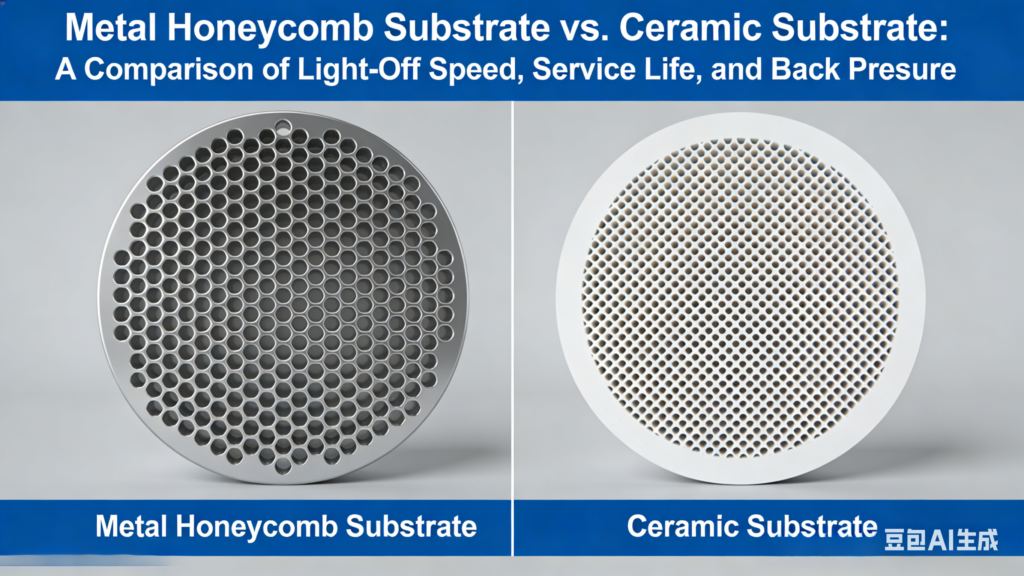
Are you torn between choosing a metal honeycomb substrate and a ceramic substrate for your catalytic carrier? Unsure which is better suited for your product, worried that the wrong choice might lead to slow light-off, short service life, or high back pressure, ultimately compromising overall performance? Leveraging years of export experience, we provide a detailed comparison across core performance dimensions to help you make a quick, informed decision.
Metal honeycomb substrates outperform ceramic substrates in light-off speed, service life, and impact resistance. They offer lower back pressure and are suitable for a wider range of applications. Ceramic substrates only hold an advantage in initial procurement cost, making them suitable for standard, low-load, cost-sensitive scenarios. The core differences between the two are concentrated in three key dimensions: light-off, service life, and back pressure.
As a manufacturer of both substrate types, we do not favor one product over the other. Our approach is to help you select the most suitable carrier type based on your specific needs.
Light-Off Speed Comparison: Metal Substrates Win, Offering Better Cold-Start Emissions
Light-off speed is a core performance metric for catalytic carriers, directly impacting cold-start emissions and is critical for meeting stringent standards like Euro 6 and China 6.
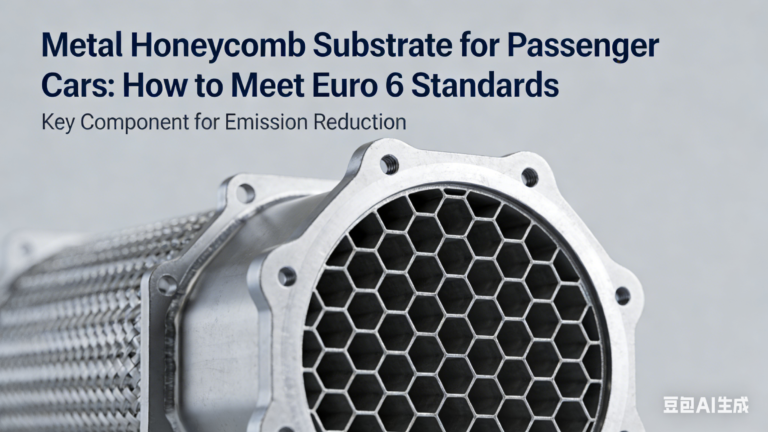
Metal honeycomb substrates are made from FeCrAl alloy foil with a thickness of only 0.03–0.05 mm. They exhibit excellent thermal conductivity, allowing them to rapidly absorb exhaust heat. They typically reach the catalyst’s optimal operating temperature (250–300°C) within 30–50 seconds, achieving fast light-off and effectively reducing cold-start pollutant emissions.
Ceramic substrates are made from cordierite, which has a thicker wall (0.1–0.2 mm) and poor thermal conductivity. They light off more slowly, typically requiring 60–90 seconds to reach the optimal operating temperature, making it difficult to meet stringent cold-start emission standards.
For overseas customers needing to meet high emission standards such as Euro 6 or EPA, the light-off advantage of metal substrates is particularly significant and is a core competitive strength for our exports to European and American markets.
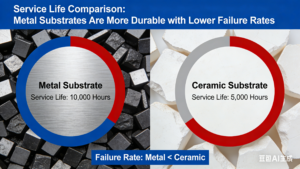
Service Life Comparison: Metal Substrates Are More Durable with Lower Failure Rates
Service life directly impacts customer operating costs and product reputation. The difference in durability between the two is substantial.
Metal substrates, made from FeCrAl alloy, offer excellent high-temperature resistance, thermal shock resistance, and vibration resistance. They withstand rapid thermal cycling and frequent vibration in exhaust environments without easily cracking, deforming, or oxidizing. Under standard conditions, their service life reaches 80,000–100,000 kilometers; in heavy-duty or industrial scenarios, it reaches 50,000–80,000 kilometers.
Ceramic substrates are relatively brittle, with poor thermal shock and vibration resistance. Under rapid thermal cycling or high-vibration conditions, they are prone to cracking and breakage. Their service life is typically only 30,000–50,000 kilometers, with a failure rate significantly higher than that of metal substrates.
For long-term use scenarios such as fleets, construction machinery, and overseas aftermarket applications, the extended service life of metal substrates effectively reduces replacement and maintenance costs.
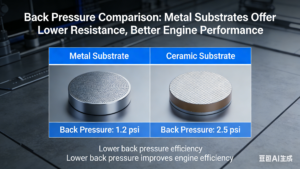
Back Pressure Comparison: Metal Substrates Offer Lower Resistance, Better Engine Performance
Back pressure is a critical parameter for exhaust systems. Excessive back pressure can lead to reduced engine power and increased fuel consumption, negatively impacting overall product performance.
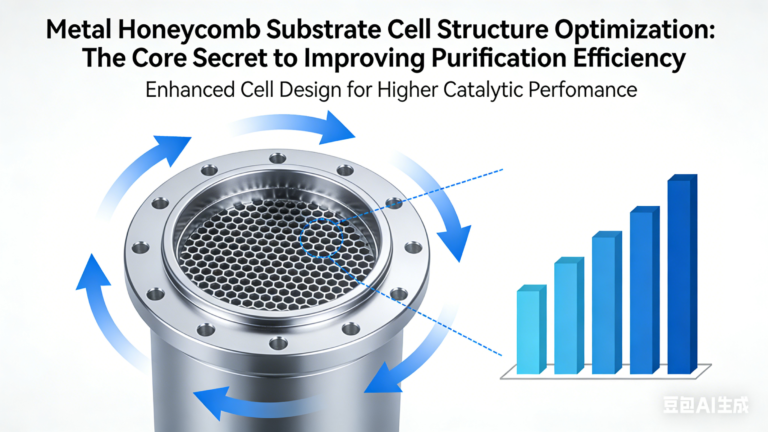
Metal honeycomb substrates feature extremely thin foil and a uniform, smooth cell structure, resulting in low exhaust resistance. Back pressure typically ranges from 5–10 kPa. This effectively reduces the exhaust load on the engine, enhancing engine power and fuel economy. This benefit is particularly pronounced for turbocharged and large-displacement engines.
Ceramic substrates have thicker walls and relatively narrower cell structures, leading to higher exhaust resistance. Back pressure typically ranges from 10–15 kPa. Prolonged use can cause the engine to feel sluggish, reduce power output, and increase fuel consumption.
Many overseas customers report noticeable improvements in engine power and a 5%–10% reduction in fuel consumption after switching to metal substrates. This is a key reason why metal substrates are increasingly favored by customers worldwide.
Other Key Differences: Application Scenarios and Cost
Beyond light-off speed, service life, and back pressure, there are notable differences in application scenarios and cost, allowing for selection based on specific needs.
Application Scenarios: Metal substrates have a broader range of applications. They are suitable for passenger cars, motorcycles, heavy-duty equipment, industrial catalysis, and various other scenarios, especially those involving stringent emission requirements, high temperatures, and high vibration. Ceramic substrates are primarily used in standard passenger cars and low-load applications; they are not suitable for heavy-duty, high-temperature, or high-vibration environments.
Cost: Ceramic substrates have an initial procurement cost 10%–20% lower than metal substrates. However, considering long-term use, metal substrates offer lower failure rates and reduced replacement costs, resulting in better overall cost-effectiveness. For cost-sensitive customers with simple application scenarios, ceramic substrates may be a viable option. For customers with performance and longevity requirements, metal substrates are the superior choice.
Frequently Asked Questions
How should I choose if I prioritize cost-effectiveness?
For standard passenger vehicles or low-load scenarios with less stringent emission requirements, a ceramic substrate can be chosen to minimize initial procurement costs. For scenarios involving stringent emission standards, heavy-duty operation, or long-term use, a metal substrate is recommended as it offers lower total cost of ownership over the long term.
Can the cost of metal substrates be reduced through bulk purchasing?
Yes. We support large-volume wholesale orders. Higher volumes typically result in lower unit prices. We also offer flexible lead times and logistics solutions to help overseas customers reduce procurement and shipping costs.
Can the same catalyst coating be used for both substrate types?
Yes. The surface of both substrate types can be coated with a catalyst washcoat. The coating process is consistent. Different precious metal coating formulations can be applied based on customer requirements to meet various purification targets.
Conclusion
Metal substrates outperform ceramic substrates in core performance aspects such as light-off speed, service life, and back pressure, and are suitable for a wider range of applications. Ceramic substrates are only preferable for cost-sensitive scenarios with simple requirements. Choosing based on your specific application scenario and needs is essential to achieving the optimal balance between performance and cost.