
As a B2B purchaser or overseas buyer, are you often confused by conflicting specifications and struggling with the selection process when sourcing three-way catalyst metal honeycomb substrates? You may either fail to find core parameters that fit your exhaust system or cannot precisely match the three mainstream cell density options—400, 600, and 900 CPSI—resulting in purchased substrates that fail to meet emission requirements or application needs. With over a decade of experience specializing in the R&D and production of metal honeycomb substrates, combined with our global export expertise, we have compiled this guide to core parameters and selection strategies. Our goal is to help you quickly choose the right product and minimize procurement risks.
Our three-way catalyst metal honeycomb substrates cover the full range of core cell densities: 400, 600, and 900 CPSI. They are manufactured from high-purity FeCrAl (iron-chromium-aluminum) alloy. Both standard sizes and non-standard customizations are available. Our core parameters strictly comply with major global emission standards such as Euro 6, EPA, and China 6, and our substrates are suitable for diverse applications including passenger cars, motorcycles, and construction machinery. We help B2B buyers complete their selection and procurement efficiently.
The core parameters of three-way catalyst metal honeycomb substrates directly determine their compatibility and purification performance. Understanding these key parameters and the logic behind the selection process can effectively help you avoid procurement pitfalls and improve sourcing efficiency. Below, we provide a detailed explanation from three dimensions: analysis of core parameters, selection methods, and key considerations.
Detailed Explanation of Core Parameters: Understanding 400/600/900 CPSI and Key Indicators
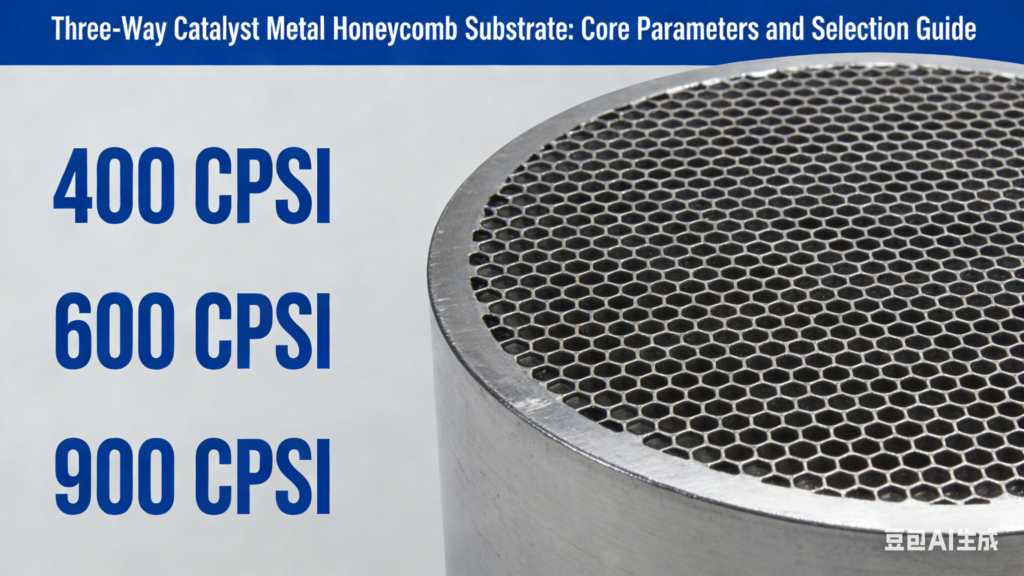
When sourcing metal honeycomb substrates, the core parameters to focus on are cell density (CPSI), material, and dimensions. Among these, cell density is central to the selection process. The three main specifications—400, 600, and 900 CPSI—cover the vast majority of global applications, each with clearly defined suitable boundaries.
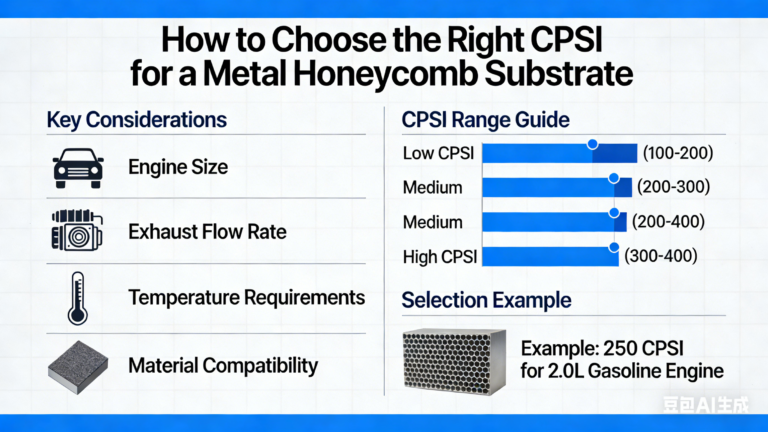
Cell Density (CPSI): Refers to the number of cells per square inch. Higher cell density means finer channels, a larger specific surface area, and higher purification efficiency, but it also increases back pressure. Lower cell density means wider channels, lower exhaust resistance, and lower back pressure, making it suitable for high-flow exhaust scenarios.
-
400 CPSI: Low cell density, low back pressure, with larger cell diameters. Suitable for high-displacement, high exhaust flow scenarios such as heavy-duty equipment including trucks, construction machinery, and generator sets. Effectively prevents dust and debris from clogging the channels, maintaining stable performance under prolonged, high-intensity operation. This is our core specification for exports to heavy-duty markets in Southeast Asia and Africa.
-
600 CPSI: Medium cell density, balancing purification efficiency and back pressure. This is a general-purpose specification suitable for most passenger cars (sedans, SUVs) and conventional commercial vehicles. It meets mainstream emission standards like Euro 6 and China 6, balancing purification performance with engine power. It is the preferred specification for the global aftermarket and OEM applications, offering the largest purchase volume and widest applicability.
-
900 CPSI: High cell density, high purification efficiency. The fine channels provide a large specific surface area, allowing more thorough contact between exhaust gas and the catalyst. Suitable for small-displacement passenger cars, motorcycles, and small engines, enabling rapid exhaust purification to meet stringent emission requirements in regions like Europe and North America. Particularly well-suited for applications with demanding cold-start emission requirements.
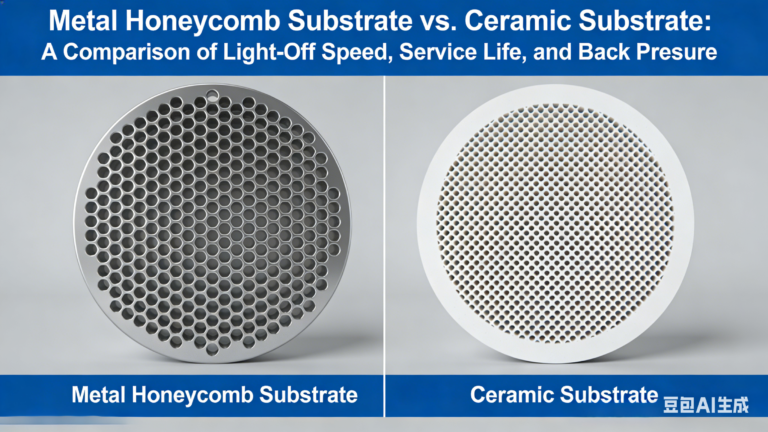
Material Parameters: We uniformly use FeCrAl (iron-chromium-aluminum) alloy foil with a thickness controlled between 0.03–0.05 mm. It withstands temperatures up to 1200°C and offers excellent oxidation and thermal shock resistance, allowing it to endure the high-temperature, high-vibration environment of exhaust systems over the long term, with a service life far exceeding that of standard stainless steel substrates. Additionally, the material’s good thermal conductivity facilitates rapid catalyst light-off, enhancing purification efficiency.
Dimensional Parameters: Standard diameters range from 50 mm to 200 mm. Length can be adjusted according to customer requirements (typically 50–150 mm). We support non-standard size customization for round, oval, racetrack, and other shapes, adapting to the installation space of different exhaust systems without the need for additional exhaust pipe modifications, thereby reducing adaptation costs.
Accurate Selection Guide: Quickly Match Specifications Based on Application Scenario
Many B2B purchasers fall into the trap of equating higher cell density with better performance, blindly opting for 900 CPSI specifications. This can lead to excessive back pressure, affecting engine power and even shortening the substrate’s service life. The correct selection logic is “match the scenario, prioritize requirements.” Combine your product’s application scenario, emission requirements, and engine parameters to quickly match the appropriate specification.
Scenario 1: Passenger Cars (Sedans, SUVs) – Prioritize 600 CPSI. Most passenger cars have engine displacements between 1.0–2.5L with moderate exhaust flow. 600 CPSI balances purification efficiency and back pressure, meeting Euro 6 and China 6 emission standards without compromising engine power. It is suitable for both aftermarket replacement and OEM applications, offering reasonable procurement cost and the best overall value.
Scenario 2: Heavy-Duty Equipment (Trucks, Construction Machinery, Generator Sets) – Prioritize 400 CPSI. These applications feature large-displacement engines with high exhaust flow, often operating in dusty, high-intensity environments. The low back pressure design of 400 CPSI reduces exhaust resistance and prevents channel clogging. Its high-temperature and vibration resistance adapt to extreme operating conditions, extending service life.
Scenario 3: Small-Displacement Vehicles (Motorcycles, Small Engines) – Prioritize 900 CPSI. Small-displacement engines have low exhaust flow. The high cell density of 900 CPSI maximizes specific surface area, enhancing purification efficiency and enabling the catalyst to reach its optimal operating temperature quickly. It meets stringent emission requirements in regions like Europe and North America, and its compact size fits small exhaust systems.
Scenario 4: Customized Requirements – Adjust Parameters as Needed. If your product involves special scenarios (e.g., non-standard exhaust system shapes, unique emission requirements), we can flexibly adjust parameters including cell density (customizable from 200–900 CPSI), dimensions, and shape. Based on your engine parameters and exhaust flow, we will provide a dedicated selection solution to ensure perfect substrate compatibility.
Key Considerations for Selection: Avoiding Procurement Pitfalls
As a B2B purchaser, beyond focusing on core parameters, pay attention to the following three points to avoid losses due to incorrect selection.
First, avoid blindly pursuing high CPSI: Cell density must match engine displacement and exhaust flow. Using 900 CPSI with a small-displacement engine will cause excessive back pressure, reducing engine power and increasing fuel consumption. Using 900 CPSI with a large-displacement engine can lead to channel clogging, substrate failure, and increased replacement costs.
Second, clarify material requirements: Different scenarios have varying demands for temperature resistance and corrosion resistance. For industrial catalysis and high-temperature exhaust scenarios, select FeCrAl alloy with higher temperature resistance (withstanding up to 1200°C). Avoid standard stainless steel substrates (withstanding only up to 800°C), as they will age and fail rapidly.
Third, confirm compatibility in advance: Before purchasing, provide parameters such as engine displacement, exhaust flow, and exhaust system dimensions. We will conduct precise compatibility testing to ensure the substrate perfectly matches your product, avoiding issues like “unable to install” or “purification efficiency failing to meet standards.”
Frequently Asked Questions About Selection
Is there a significant price difference among the 400, 600, and 900 CPSI specifications?
Price differences primarily depend on cell density and production process. Due to finer channels and greater production complexity, 900 CPSI is approximately 10%–15% more expensive than 600 CPSI. 400 CPSI has lower production complexity and is approximately 5%–10% less expensive than 600 CPSI. Bulk purchases qualify for more favorable pricing. We provide detailed quotations based on order volume, with transparent pricing and no hidden costs.
Are standard specifications available from stock for fast shipment?
Yes, we maintain inventory of standard-size substrates (diameter 50–200 mm, length 50–150 mm) in 400, 600, and 900 CPSI. Shipment occurs within 1–3 days after order placement. For non-standard custom specifications, production lead time is 7–30 days depending on complexity. After order confirmation, we provide real-time production updates to ensure on-time delivery.
How can I confirm that the substrate meets my emission requirements?
We can provide authoritative test reports (e.g., Euro 6, EPA, China 6 emission tests) demonstrating that the substrate’s purification efficiency complies with relevant standards. Additionally, based on your emission targets, we can optimize the substrate’s cell structure and material to ensure it meets your specific emission requirements, facilitating your product’s successful entry into target markets.
Conclusion
Selecting the right three-way catalyst metal honeycomb substrate centers on “matching the scenario and precisely defining parameters.” The three main specifications—400, 600, and 900 CPSI—cover the vast majority of applications. By combining your product’s engine parameters, emission requirements, and application scenario, you can quickly choose the correct product. As a professional manufacturer, we offer selection guidance, customization services, and quality assurance to help B2B purchasers source efficiently, reduce procurement risks, and enhance product competitiveness.