
Have you ever wondered why some metal honeycomb substrates fail prematurely while others perform reliably for the long term? The secret lies in strictly controlled precision manufacturing. In our factory, every process step is designed for stability and performance.
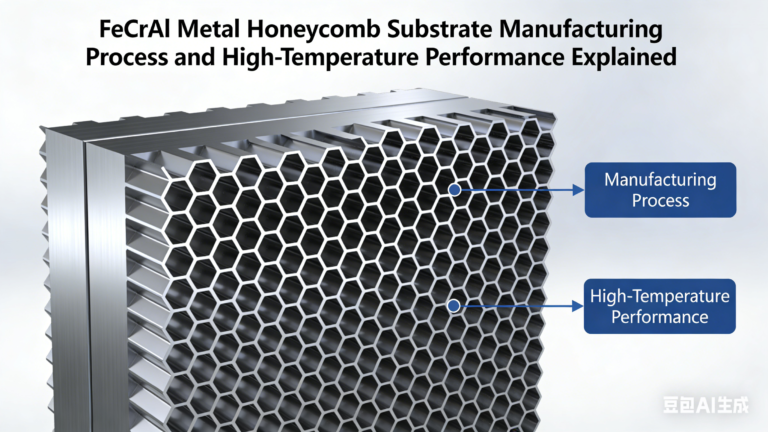
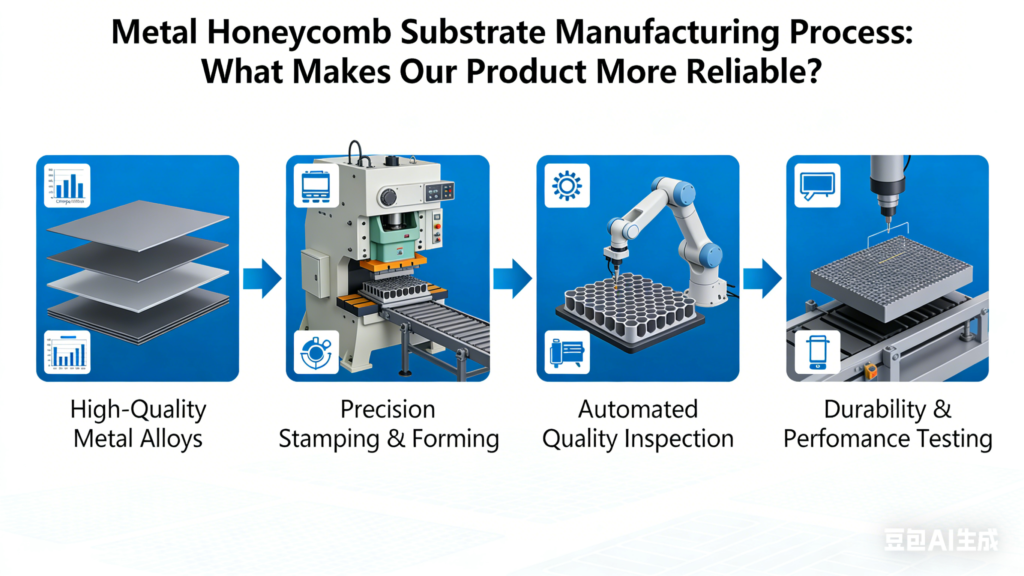
Our metal honeycomb substrate production process includes: raw material selection, foil processing, corrugation forming, winding, high-temperature brazing, cleaning, and quality inspection. Each step is rigorously monitored to ensure consistent performance for emission control systems worldwide.
We tightly control every detail to ensure that the substrates you receive are stable and reliable under real-world operating conditions.
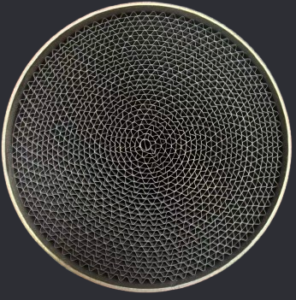
Why is Raw Material Selection Crucial?
We use only high-quality iron-chromium-aluminum (FeCrAl) alloy foil to guarantee high-temperature resistance. Low-quality foil is prone to deformation and oxidation in exhaust environments, leading to rapid failure. Our materials meet international automotive-grade standards for extended service life. Material composition is strictly inspected using spectral analysis.
How is the Metal Foil Processed Before Forming?
The foil is precisely cut to a standard thickness to ensure a uniform cell structure. Consistent thickness ensures stable gas flow and heat distribution. Any deviation can create structural weaknesses in the finished product.
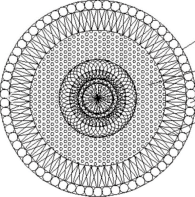
How are the Corrugation and Forming Stages Carried Out?
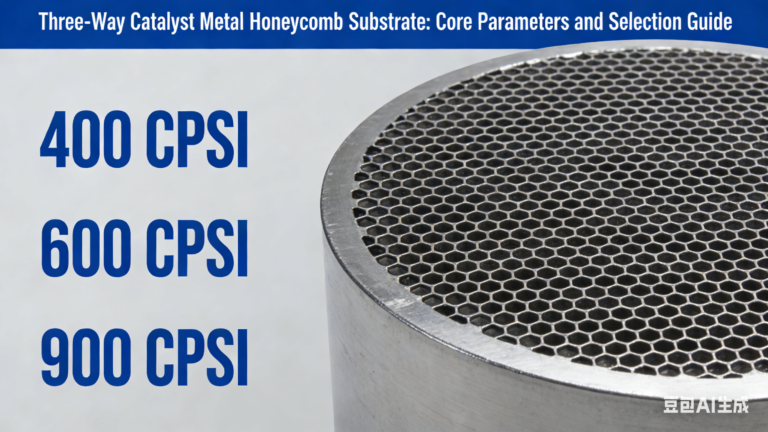
Flat foil is pressed into a corrugated shape, forming the honeycomb channel structure. The spacing of the corrugations determines the CPSI and is a core performance parameter. We maintain extremely tight tolerance control for our 400, 600, and 900 CPSI products.
How is the Honeycomb Core Wound and Assembled?
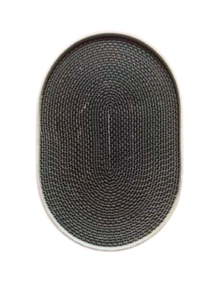
Flat and corrugated foils are stacked and wound together to form cylindrical or shaped structures. Winding tension is precisely controlled to avoid deformation or interlayer loosening. We support oval, square, and various custom winding shapes.
Why is High-Temperature Brazing So Important?
Brazing fuses the individual metal layers together, providing resistance to vibration and high temperatures. Poor brazing can lead to delamination and structural failure. We employ vacuum brazing to ensure uniform solder joints and consistent strength. Brazing temperatures are monitored in real-time throughout the process [Brazing process data placeholder link].
What Cleaning and Surface Treatment Processes Do We Use?
High-temperature cleaning removes residual oils and impurities. A clean surface improves the subsequent adhesion of the catalyst coating. Substrates treated in this way can significantly extend the life of the catalytic system.
How is Finished Product Inspection Conducted Before Shipment?
Each carrier undergoes dimensional, airtightness, and heat resistance testing. We inspect for cracks, gaps, and structural integrity. Only products that pass these checks are released for shipment to global markets.
Frequently Asked Questions
How long is the complete production cycle?
Lead times for standard orders range from several days to several weeks, depending on quantity and customization level. We support flexible production scheduling to accommodate urgent orders. In-stock inventory enables fast international delivery.
Can the process be adjusted for specific engine requirements?
Yes. We can adjust corrugation, thickness, and brazing processes to suit specialized applications. Industrial, marine, and motorcycle substrates all utilize customized production processes.
What quality standards are followed in production?
We strictly adhere to ISO and TS16949 automotive quality management systems. Every process step is traceable, ensuring consistency and stability.
Conclusion
Our manufacturing process transforms high-quality alloy into durable, high-performance substrates. Comprehensive process control ensures our products are suitable for global OEM and aftermarket exhaust systems. We continuously upgrade our processes to meet increasingly stringent global emission regulations.